Powering Energy-Efficient and Resilient Data Centers: A U.S.-Sweden Collaboration
As AI, streaming, and cloud services accelerate, data centers have become one of the fastest-growing electricity consumers in the U.S. This rapid growth is creating a structural sustainability challenge: electricity demand is rising faster than the power system’s ability to expand cleanly and reliably. That is where Swedish innovation may come in. Sweden and the U.S. are uniquely positioned to collaborate on clean, efficient digital infrastructure, specifically when it comes to advanced cooling technologies and heat reuse. Sweden leads in both of these areas, providing the perfect opportunity for U.S.-Swedish alignment while the U.S. will need to adopt new solutions to maintain data center deployment targets.
In this article, we will highlight the rising energy footprint of U.S. Data Centers, explain why energy efficiency practices are becoming a competitive advantage, describe Sweden’s energy efficient model, and present opportunities for how the Green Transition Initiative (GTI) can support in US-Sweden collaboration.
Rising Electricity Footprint of U.S. Data Centers
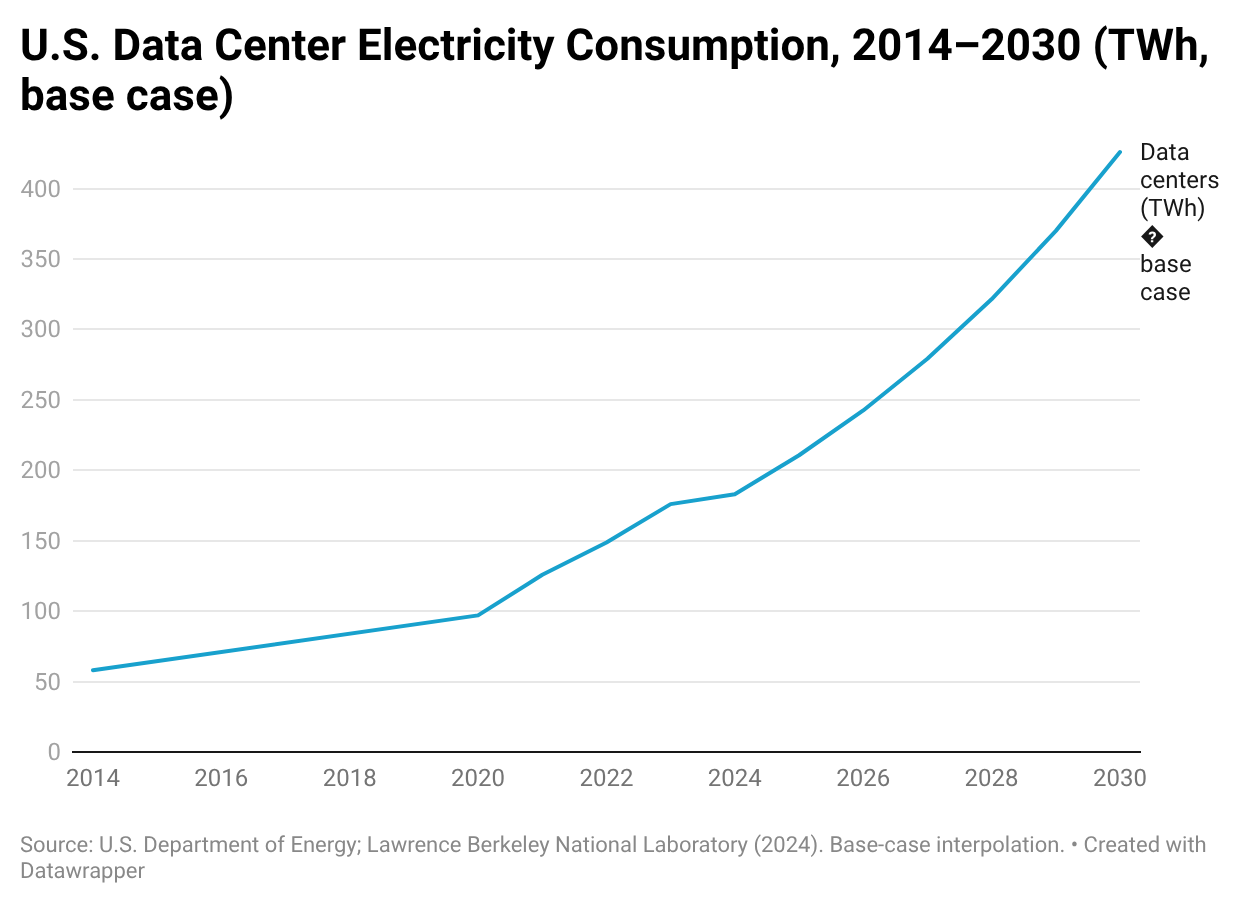
Globally, electricity consumption for data centers is projected to double, reaching around 945 TWh by 2030. From 2024 to 2030, demand is expected to grow by roughly 15% per year—more than four times faster than overall electricity consumption across all sectors. This surge is driven by rapid data center expansion, particularly in the United States, where data centers consumed 183 TWh of electricity in 2024, accounting for over 4% of total U.S. electricity use. By 2030, U.S. data center electricity demand is projected to increase by 133%, reaching 426 TWh. This growth is not evenly distributed across the country. Data center development is increasingly concentrated in power-advantaged states with abundant generation capacity and lower electricity costs, including Texas, Virginia, and parts of the Midwest and Southeast. Texas, in particular, is emerging as a major hub, with data center electricity demand projected to more than double and account for roughly 30% of total U.S. data center load by 2028.
Since data centers are often geographically concentrated, they can significantly strain power grids. A notable example is Data Center Alley, a 30-square-mile stretch outside Washington D.C.. Home to more than 200 data centers, the region consumes roughly the same amount of electricity as Boston. So that is why power company officials were alarmed when a large number of those centers suddenly dropped off the grid one summer and switched to on-site generators. The drop-off was triggered by a standard safety mechanism, intended to protect computer chips and electronic equipment from damage caused by voltage fluctuations. However, this incident caused a huge surge in excess electricity, potentially causing region-wide cascading failures, especially in areas with a concentrated data center. Controversially, some grid operators have proposed requiring data centers to “ride through” routine voltage dips without disconnecting. However, data center operators have opposed because of the risk of damaging electronic equipment and cooling systems.
Why Sustainability is Becoming a Competitive Advantage?
Sustainability and energy efficiency have become core sources of competitive advantage for data centers as electricity demand rises and grid constraints intensify. Operators that lower energy intensity, improve operational efficiency, and reuse waste heat are better positioned to secure power, manage long term costs, and maintain reliable operations. These capabilities strengthen resilience against energy price volatility, grid congestion, and permitting challenges, all of which increasingly influence where and how data centers can scale. In this context, sustainability is not simply a compliance requirement but a strategic asset that enables faster expansion, stronger utility partnerships, and long term competitiveness.
Sustainable practices are increasingly integral to corporate strategy, competitiveness, and long term value creation. Organizations that lead to sustainability not only reduce environmental impacts but also strengthen market positioning by improving risk management, attracting investment, and meeting growing expectations from customers, regulators, and partners. This alignment with sustainable and resilient operating models builds trust, deepens customer loyalty, and supports revenue growth while enabling companies to operate and scale more effectively in increasingly constrained markets.
The Swedish Model
In Sweden, sustainability is more than a mere buzzword it is a guiding principle. Sweden is a global leader in decarbonization and has targets to cut greenhouse gas emissions 59% by 2030. The country is a frontrunner in reliable, low-cost power, leveraging a combination of locally produced hydropower and a year-found mild climate that provides natural, free ambient cooling. This very fact alone makes Sweden an ideal location for cooling data centers.
Sweden exhibits a circular infrastructure planning model, supported by a strong ecosystem of technology providers across the data center value chain. Swedish companies lead in energy systems and grid solutions with companies such as ABB, Hitachi Energy, Baseload Capital and Blykalla, enabling grid connections, on-site generation and low-carbon power integration. In advanced cooling technologies and thermal management, firms such as Alfa Laval, Munters, Swegon, and Systemair deliver advanced air and liquid cooling technologies that significantly reduce energy use. Sweden is also at the forefront of heat recovery. With actors like Stockholm Exergi, FVB Climeon and EcoDataCenter capturing excess data center heat and supplying it to district energy systems. Combined with digital energy management and flexibility solutions from companies such as Flower, Ingrid Capacity and CheckWatt, this integrated approach accelerates the transition from linear infrastructure to a resource-efficient data center economy. The circular infrastructure model is a proactive strategy designed to transition from a linear “take-make-dispose" system to a sustainable, resource-efficient economy. Many Swedish firms aim to accelerate the transition towards a sustainable future.
Power Supply and Energy Systems
Rapid growth in U.S. data center capacity is increasingly constrained by grid integrity challenges. In the United States, data center developers are facing long interconnection queues, localized congestion, and delayed approvals. These constraints are already slowing project deployment and prompting developers to pursue costly stopgap solutions.
A core issue is that large data centers are often integrated into the grid as inflexible, passive loads. Limited coordination between utilities, grid operators, and data center developers means that load growth frequently outpaces transmission upgrades, system reinforcement, and flexibility planning. U.S. regulators have increasingly acknowledged that this disconnect poses growing risks to reliability, particularly in regions experiencing clustered data center development, such as the Mid-Atlantic and parts of the Midwest.
Sweden has a strong ecosystem of grid and energy technology providers. This spans across grid connection technologies, power electronics, and digital monitoring tools. By combining robust infrastructure with digital control and energy management. There are examples of accelerating data center integration in a way that strengthens rather than strains the electricity system.
ABB illustrates how Swedish power system expertise can support large-scale data growth while maintaining grid integrity. The company is at the forefront of a major shift towards a more flexible, interactive, and automated grid.
Ultimately, developing solutions that balance operational safety with grid resilience will be crucial as data centers continue to grow and play an increasingly vital role in the digital economy.
Liquid Cooling
The rise in electricity use is linked to data center overheating because IT equipment converts almost all electricity it consumes into heat. According to new research, data centers are creating “heat islands,” warming the land around them up to 16 degrees Fahrenheit. Strikingly, the impacts were not limited to a data center’s immediate surroundings. In fact, temperature increases affected areas up to 6.2 miles away, affecting more than 340 million people.
Liquid cooling has emerged as a transformative addition to traditional air-based cooling systems. By utilizing liquid to cool components directly, this approach achieves more efficient heat dissipation compared to air, enhancing thermal management across data centers. This process not only boosts cooling efficiency but also helps lower the overall energy footprint, making it an appealing solution for handling intensive AI workloads.
There are two primary approaches to liquid cooling: Immersion cooling and direct-to-chip cooling. Immersion cooling involves submerging IT hardware in a specifically designed dielectric fluid, such as mineral oil or synthetic coolants. The fluid effectively absorbs and dissipates heat directly from the components, eliminating the need for traditional air-cooled systems. By directly cooling the hardware, immersion cooling greatly enhances energy efficiency and reduces operating costs. On the other hand, direct-to-chip cooling focuses on delivering coolant directly to the heat-generating components of servers. The versatility of liquid cooling technologies offers data center operators a strategic advantage, enabling them to customize cooling solutions to meet specific infrastructure and AI workload needs. Swedish companies such as Alfa Laval are currently pioneering advanced liquid cooling solutions, setting benchmarks for sustainable and efficient data center operations.
District Heating
A way data centers can manage the excess heat rejected from the data centers and reuse it into our local homes and businesses. Nearly all electrical energy consumed in a data center is ultimately converted into thermal energy (heat), of which around 70-80% is recoverable using heat pumps. With this approach, the excess data center heat can be converted to district heating, essentially a system of insulated pipes leading from the data center and distributed across multiple buildings in the local area.
Sweden has one of the most extensive District Heating systems in the world, supplying roughly 50% of national space heating demand, compared to under 2% in the U.S. In fact, an initiative called Stockholm Data Parks run in partnership with political and industry leaders to warm people’s homes using waste heat generated by the city’s data centers. District Heating allows waste heat to be distributed at city scale, turning what would be rejected heat into a system resource rather than a local one.
In addition to its extensive coverage and integration with local data centers, Sweden’s district heating system is renowned for its adaptability and environmental benefits. The system utilizes a variety of energy sources, including biomass, waste-to-energy, and recovered industrial heat, making it highly resilient and less dependent on fossil fuels. This multifaceted approach not only reduces greenhouse gas emissions but also strengthens energy security by diversifying supply. Furthermore, district heating networks in Sweden are continuously modernized to increase efficiency and accommodate new technologies, such as heat recovery from data centers, which aligns perfectly with the country’s circular infrastructure planning and decarbonization goals.
A notable company within District Heating is Stockholm Exergi. Based in Stockholm, they are an energy company partners with data center operators to capture excess heat and feeds it directly into Stockholm’s district heating network. This model shows how data centers can be integrated into existing urban energy infrastructure, reducing waste heat, lowering emissions, and improving overall system efficiency rather than treating heat as a by-product to be discarded.
How GTI Supports the Ecosystem
The Green Transition Initiative (GTI) plays a convening role at the intersection of digital infrastructure, energy systems, and climate leadership. We are able to support the U.S.-Sweden data center ecosystem by:
• Connecting demand and solutions: Bridging U.S. data center operators, utilities, and public stakeholders with Swedish companies specializing in energy-efficient cooling, heat recovery, and circular infrastructure.
• Convening cross-sector dialogue: Creating platforms for collaboration among industry, government, and research institutions to address grid constraints, energy efficiency, and climate goals.
• Innovation discussions: Facilitating forward-looking discussions among policymakers, researchers, utilities, and technology providers to explore emerging solutions for grid resilience, energy-efficient data center design, and system integration, while informing future technology development and policy direction.
• Enabling market entry and pilots: Work with Team Sweden to help Swedish technology providers navigate U.S. market conditions, identify demonstration opportunities, and engage with relevant regional partners.
In 2026, GTI will support programming that link market insight with direct engagement. The initiative will bring Swedish companies into direct dialogue with hyperscalers, colocation operators, EPCs, utilities, investors, and public stakeholders. Alongside this, GTI will contribute market analysis and insight reports to clarify regulatory developments, grid conditions, and regional priorities. Our initiative is relevant for Swedish companies active in power and grid infrastructure, energy-efficient cooling, heat recovery, energy management and flexibility, and modular or prefabricated data center solutions. Swedish companies working in these areas are encouraged to reach out to GTI to explore participation and engagement opportunities.